
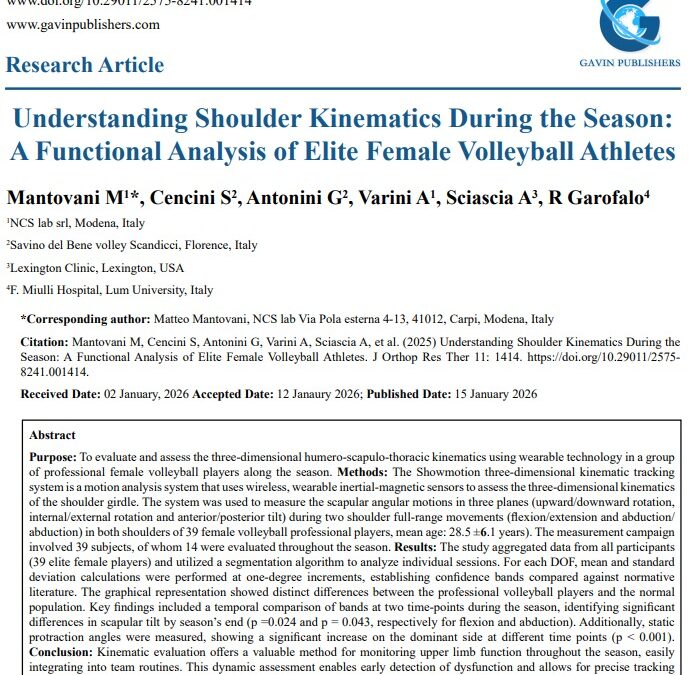
Elite volleyball imposes high repetitive loads on the upper extremity (serving and spiking) with significant demands for strength, speed, and motor control. In the presence of muscular imbalances or altered scapular kinematics, the athlete may develop compensations (scapular substitution) which, if unidentified, predispose them to pain, performance decline, and overuse injuries.
Traditional assessments (standard clinical exams and active ROM) often fail to detect subtle deficits in coordination and intersegmental control. ShowMotion bridges this gap by providing a quantitative map of scapulothoracic and scapulohumeral kinematics during standardized functional movements (flexion, abduction, rotations).
Key Findings
- Identification of “scapular dyskinesis” patterns in apparently asymptomatic athletes.
- Associations between alterations in scapulohumeral rhythm and phases of loading/fatigue.
- Utility in calibrating prevention exercises (scapular control, ER/IR balance) and modulating technical loads.
Practical Implications for Technical and Medical Staff
- Pre-season screening for individual baselines; in-season monitoring to detect changes.
- Objective feedback for physiotherapists and strength & conditioning coaches regarding technique and motor control.
- Return-to-play support: pre-injury vs. post-rehab comparison; definition of data-driven safety thresholds.
Suggested Workflow for In-Season Monitoring
- Frequency: Bi-weekly or monthly assessments, and following intense loads (tournaments, match blocks).
- Standard Movements: Flexion, abduction, rotations; 6–8 repetitions for variability and hysteresis analysis.
- Key Indicators: SHR (Scapulohumeral Rhythm), scapular tilt, angular dispersion, dominant vs. contralateral side asymmetries.
- Decisions: Load progressions and personalized prevention; triggers for further clinical investigation.
Why ShowMotion is Unique
- Ecological 3D measurements: Repeatable and portable directly on the court or in the clinic.
- Immediate integration into daily decision-making (clear visualizations, automated reports).
- Alignment with data-driven (value-based) medicine for performance and prevention.
Conclusions
In-season monitoring of shoulder kinematics with ShowMotion offers a competitive advantage by detecting compensations and dysfunctions early, guiding targeted interventions for prevention and performance optimization. The systematic integration of this assessment into the routine of technical and medical staffs can reduce injury risk and support consistent performance in elite athletes.
Call to Action
For sports clubs, medical staffs, and performance teams: launch a structured in-season functional monitoring program with ShowMotion, defining key indicators and shared decision-making thresholds. The transition from episodic evaluations to continuous, data-driven control represents a strategic shift toward sustainable performance.
https://www.gavinpublishers.com/article/view/understanding-shoulder-kinematics-during-the-season-a-functional-analysis-of-elite-female-volleyball-athletes
Commenti recenti