
Why Clinical Success Isn’t Always Biomechanical Success: A New Era for Shoulder Kinematics
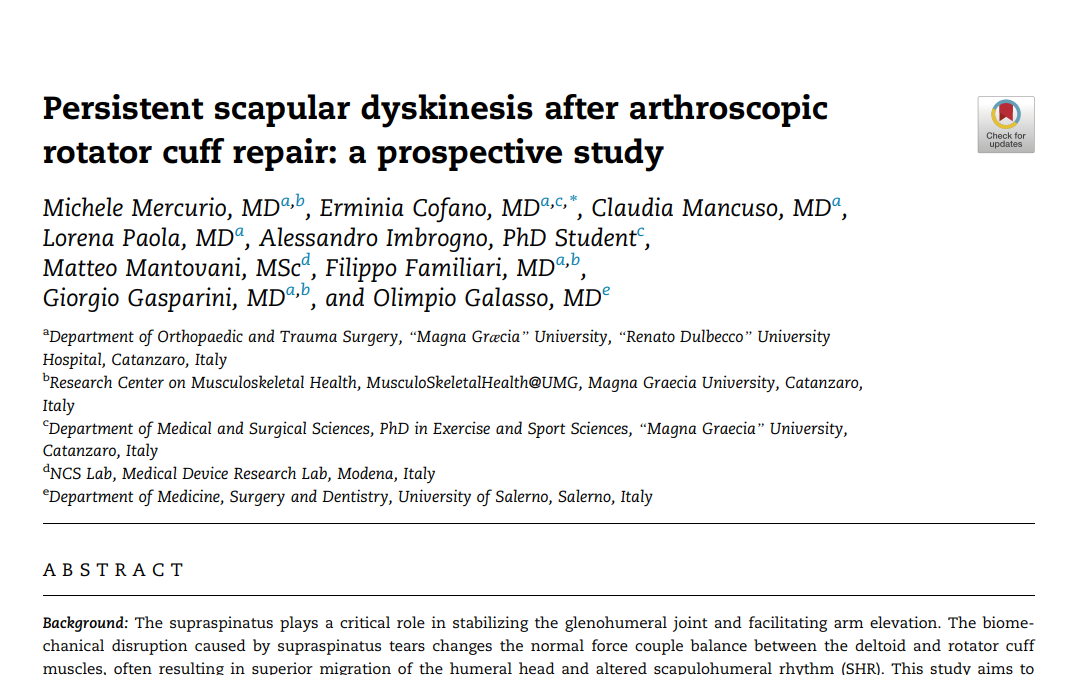
Is a “successful” surgery really enough? New research published in JSES International highlights a critical gap in recovery following rotator cuff repair: persistent scapular dyskinesis.
Although patients often show significant improvements in pain and strength (CMS scores) and in active range of motion, the scapulohumeral rhythm (SHR) frequently fails to return to normal. This “scapular substitution” could be the hidden factor behind long-term outcomes and potential re-injuries.
The Game Changer: ShowMotion – 3D Kinematic Tracking
To unveil these subtle functional deficits, the study utilized the ShowMotion 3D system (NCS Lab): a cutting-edge tool that brings a new level of detail to upper limb assessment.
Why is ShowMotion Unique?
- 3D Precision: It uses wireless, non-invasive magneto-inertial units (MIMUs) to capture the three-dimensional complexity of shoulder movement (protraction, rotations, and tilt) with extraordinary accuracy (within 2.5°–6°).
- Beyond the Surface: Unlike traditional evaluations, ShowMotion differentiates the specific contributions of the scapulohumeral and scapulothoracic joints in real-time.
- Visual Insights: Through real-time graphs and 3D avatars, it provides a quantitative “map” of coordination and proprioception, identifying micro-instabilities that are invisible to the naked eye.
Take-Home Message
Surgery corrects the structure, but neuromuscular adaptation requires targeted rehabilitation. Tools like ShowMotion are essential for clinicians looking to go beyond “generic” recovery and design personalized programs focused on restoring true motor control.
It’s time to stop guessing and start measuring.
Commenti recenti